
What Caused the Collapse in South Korea’s Stock Market, KOSPI?


What Caused the Collapse in South Korea’s Stock Market, KOSPI?
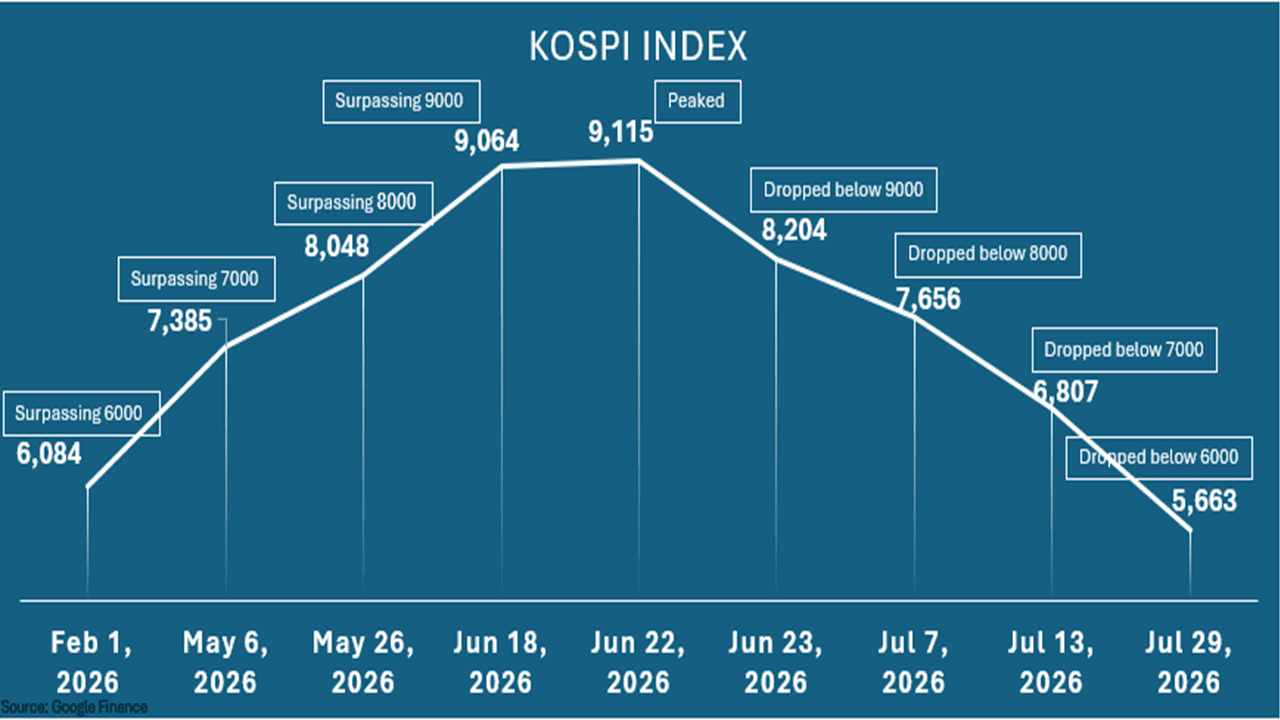
South Korea’s stock market has suffered a dramatic sell-off, wiping out more than ₩360 trillion (roughly a quarter of a trillion U.S. dollars) in market value in just a matter of days.
So, what exactly happened? And why did the sell-off become so severe?
There were several factors behind the collapse, but three developments stand out:
1. The Rise of Leveraged Investing and Forced Liquidations
One of the biggest concerns for the Korean government has been the growing flow of domestic capital into U.S. financial markets. More and more Korean investors have been buying American technology stocks and other U.S. assets, raising concerns that capital that could otherwise support Korea’s own economy and technology sector is flowing overseas.
In response, Korean authorities introduced investment products designed to encourage investors to remain in the domestic market. Among them was highly leveraged product (Single-stock leveraged ETF) soffering investors twice the daily performance of selected Korean stocks.
Such product focused on just two of Korea's largest technology companies: SK Hynix and Samsung Electronics, (they account for 54% of the Korea's main stock market; KOSPI)
The appeal was obvious. If the underlying stocks rose by 5%, the leveraged product could theoretically generate a 10% return. But the same mechanism works in reverse: a 5% decline could produce a 10% loss.
This encouraged some investors to take on additional leverage through their brokers. For example, an investor with ₩1,000 could borrow an additional ₩1,000 and invest ₩2,000 in stocks. The investor would then owe interest on the borrowed funds.
Of course, the problem arises when markets fall sharply.
If the value of the securities used as collateral drops significantly, brokers can issue a margin call, requiring investors to deposit additional cash. If investors cannot meet those demands, the broker can forcibly sell their positions to recover the money it lent.
When thousands of investors are forced to sell at the same time, the result can be a vicious cycle:
Falling stock prices creates margin calls, which creates, forced selling, which results in even lower stock prices, and hence more margin calls.
This creates a feedback loop that can turn a normal correction into a much more severe market sell-off.
2. The SpaceX Effect
Another factor was the emergence of investment opportunities outside South Korea, particularly the highly anticipated public offering of SpaceX.
As investors and funds sought exposure to the rapidly growing space and technology sector, some capital was reportedly redirected away from Korean equities and toward SpaceX-related opportunities.
For institutional investors, this can create an additional source of selling pressure. Funds that need to raise cash or rebalance their portfolios may sell existing Korean holdings in order to participate in new opportunities elsewhere.
The result is another flow of capital away from the Korean market.
3. SK Hynix and the Shift Toward U.S. Markets
The third factor was SK Hynix, one of the most important companies in the Korean stock market and a major global player in the semiconductor and artificial intelligence supply chain.
Because SK Hynix represents a significant portion of Korea's overall market capitalization, movements in the stock can have an outsized impact on the broader KOSPI index.
But what is particularly interesting is that SK Hynix itself decided to list its stock on the U.S. market, seeking to raise approximately $26.5 billion. The offering was reportedly heavily oversubscribed, with demand reaching roughly $200 billion. This illustrates just how much global investor appetite has shifted toward U.S. capital markets and technology-related investments.
As global investors increasingly seek exposure to U.S. technology, semiconductors, and artificial intelligence companies, capital is increasingly flowing toward U.S.-listed opportunities.
This creates a difficult situation for South Korea.
The country is home to some of the world's most important semiconductor companies, yet even these companies may increasingly look toward U.S. capital markets to access deeper pools of global capital.
For investors, the U.S. market offers greater liquidity, deeper capital markets, broader institutional participation, currency risk management, and easier access to global investors. This makes U.S. markets increasingly attractive not only to international investors, but also to major Korean companies themselves.
The result is a structural shift in global capital flows: money is moving out of Korean equities and into U.S. technology and AI investments.
The Human Cost
The sell-off has not only affected institutional investors.
Hundreds of thousands of Korean retail investors have reportedly been caught in the downturn, with many facing significant losses. Some investors who used leverage have been forced to deposit additional cash into their brokerage accounts to prevent their positions from being liquidated.
This is where the market decline becomes particularly dangerous.
When investors are highly leveraged, even a relatively modest decline in the underlying market can cause disproportionately large losses. Once forced selling begins, it can amplify the decline and push prices significantly below levels justified by fundamentals.
Government Intervention
The Korean government has responded by attempting to contain the damage and reduce the risk of another wave of forced selling.
Authorities have moved to restrict the creation of certain highly leveraged investment products and have taken steps to limit access to some high-risk investment strategies.
The broader message is clear: policymakers are increasingly concerned that excessive leverage and speculative retail investing could destabilize the country's financial markets.
The Bigger Picture
The collapse of the KOSPI is not simply a story about one bad week in the stock market.
It highlights a much bigger problem facing South Korea: capital is becoming increasingly global, while the Korean economy remains heavily dependent on a relatively small number of large technology companies.
At the same time, Korean investors are increasingly looking toward the United States for investment opportunities, particularly in artificial intelligence, semiconductors, and other high-growth technology sectors.
That creates a difficult dilemma for policymakers.
The recent KOSPI collapse demonstrates what can happen when high leverage, concentrated market exposure, forced liquidations, and international capital flows all collide at the same time.