
S&P 500 vs TASI Returns


S&P 500 vs. TASI: How the U.S. and Saudi Stock Markets Have Performed Over Time?
When comparing global stock markets, most emering markets are compared to S&P 500 benchmark. However, both serve as the primary indicators of their respective equity markets, they differ significantly in composition, sector exposure, maturity, and long-term performance.
The S&P 500 tracks approximately 500 of the largest publicly traded companies in the United States and is widely regarded as the best representation of the U.S. stock market. The index is float-adjusted market capitalization weighted, meaning larger companies have a greater influence on its performance. It offers broad exposure across sectors such as technology, healthcare, financials, consumer goods, industrials, and energy. Because many of its constituents are multinational corporations generating revenue worldwide, the S&P 500 is often viewed as a proxy for both the U.S. economy and global economic growth.
The Tadawul All Share Index (TASI) represents the performance of all eligible companies listed on the Saudi Exchange. Like the S&P 500, it is also free-float market capitalization weighted, allowing larger companies to have a greater impact on the index. TASI is heavily influenced by sectors such as banking, energy, materials, telecommunications, and increasingly healthcare, technology, and consumer services. As Saudi Arabia's capital market continues to expand and attract foreign investment, TASI has become one of the most significant stock market indices in the Middle East.
The S&P 500: Decades of Consistent Wealth Creation
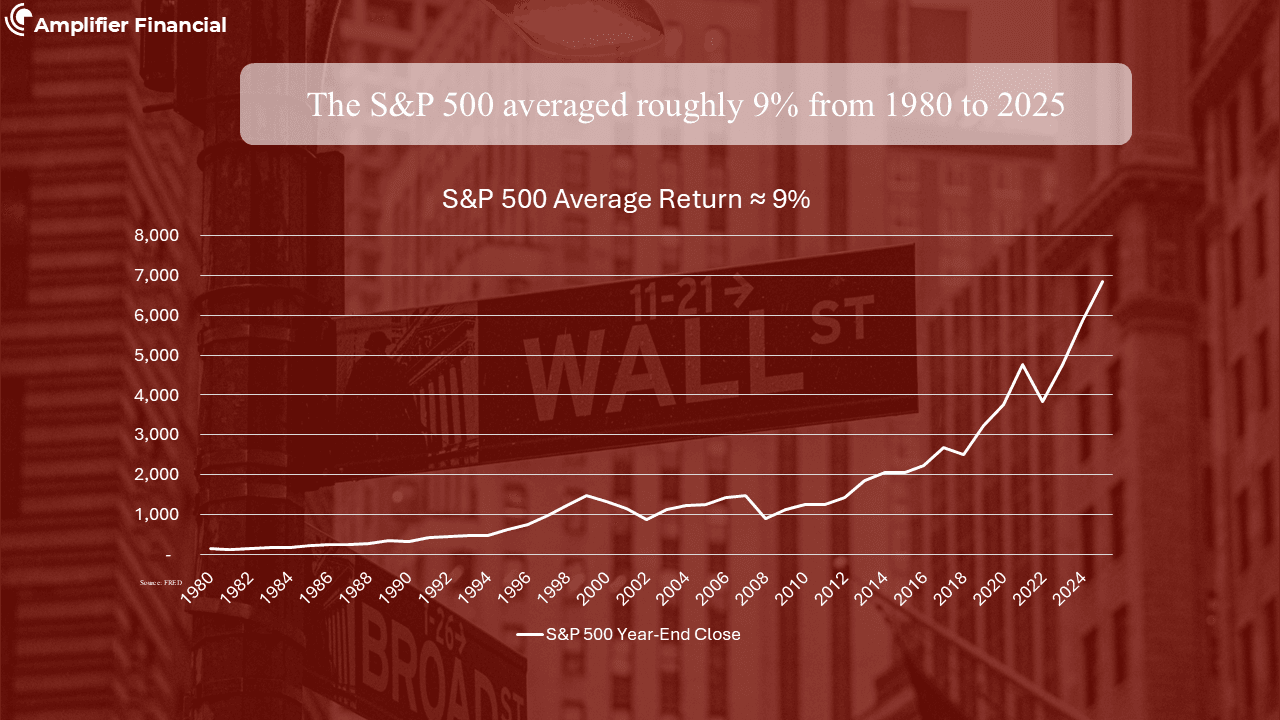
Over the long term, the S&P 500 has delivered one of the strongest investment records of any major equity market. From 1970 through 2025, the index generated an average annual return of approximately 9.1%.
This remarkable performance has been driven by several factors, including sustained economic growth, technological innovation, productivity improvements, and the global dominance of many U.S. companies. Businesses such as Apple, Microsoft, NVIDIA, Amazon, Alphabet, and many others have transformed entire industries while creating enormous value for shareholders.
Although the S&P 500 has experienced significant downturns (including the Dot-com Crash, the Global Financial Crisis, and the COVID-19 market selloff), it has consistently recovered to reach new all-time highs over the long run. This resilience illustrates the power of long-term investing and the compounding effect of remaining invested through multiple market cycles.
TASI: A Market Positioned for Long-Term Growth
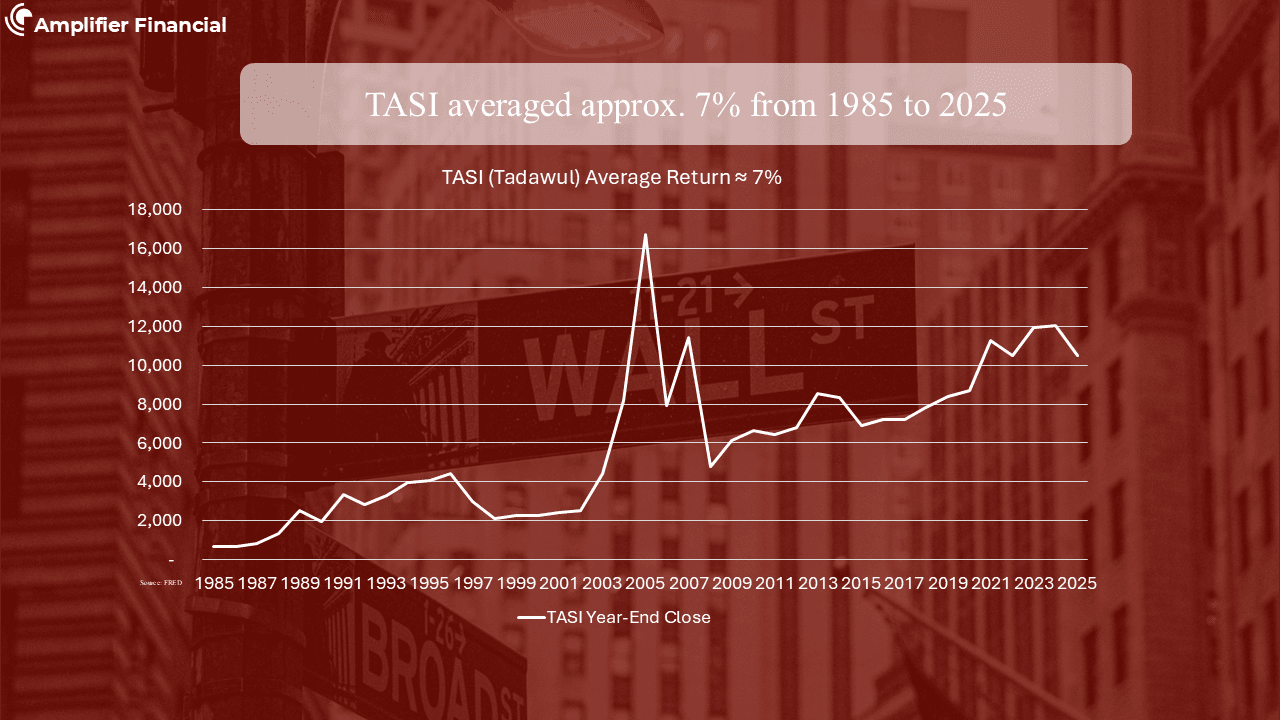
From 1985 through 2025, the Tadawul All Share Index (TASI) delivered an average annual return of approximately 7.2%. While this is slightly below the historical return of the S&P 500, it remains a strong long-term performance considering the Saudi market's shorter history, evolving regulatory framework, and greater dependence on the energy sector.
Today, however, the Saudi stock market stands at a unique point in its development. Under Saudi Vision 2030, the Kingdom is undertaking one of the world's most ambitious economic transformation programs. The strategy aims to diversify the economy beyond oil by expanding industries such as tourism, entertainment, mining, logistics, technology, renewable energy, manufacturing, and financial services.
This transformation has already led to significant capital market reforms, increased foreign investor participation, major initial public offerings (IPOs), improved corporate governance, and greater market accessibility. As more sectors contribute to economic growth and additional companies list on the Saudi Exchange, TASI has the potential to become more diversified and less dependent on oil-related industries over time.
While future returns can never be guaranteed, many investors believe these structural changes could provide a stronger foundation for long-term earnings growth and potentially enhance the market's performance over the coming decades.